

The Breakdown
The comparisons to Midnight Club aren't nostalgia bait. Rockstar built that franchise's entire identity around car culture: neon undercarriage kits, layered body modifications, and a tuning menu that let players build genuinely unique street machines rather than picking from preset trims. The GTA 6 Netflix Extended Look confirmed that same layered approach is back, and it's more granular than anything GTA Online has offered across a decade of Los Santos Customs updates.
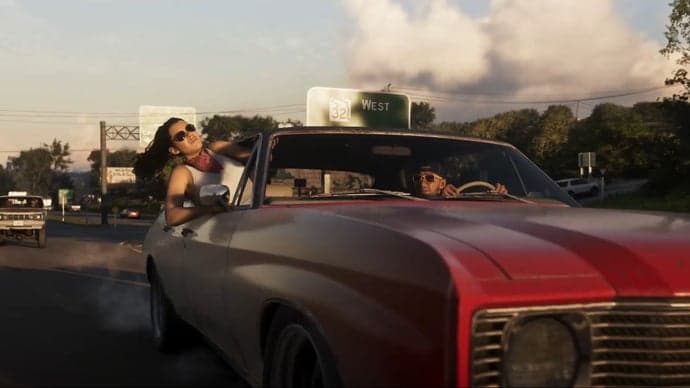
What's confirmed from the footage and subsequent breakdowns: body kits stack in visible layers rather than swapping wholesale, meaning a bumper choice, a splitter choice, and a fender flare choice all combine independently. Paint jobs interact with the RAGE 9 lighting engine dynamically, so metallics and pearlescents actually shift under Vice City's neon signage and Grassrivers' harsh daylight differently. Wheel and tire width options appear tied to physical wheel-well clearance, a detail that matters once you remember GTA 6 RAGE 9 Vehicle Physics confirmed soft-body deformation extends to how tires interact with fender geometry during collisions.
The RPG-adjacent systems Rockstar confirmed elsewhere reinforce this direction. The same detail-obsessed design philosophy behind GTA 6's RPG mechanics, where eating and exercise affect Jason and Lucia's physical stats, is clearly bleeding into vehicle systems too. If Rockstar is willing to simulate weight gain mechanics, a deep customization suite with functional consequences was never in question.
Community leak analysis (much of which Rockstar has publicly called "heartbreaking" in terms of how it spoiled unreleased content) had already pointed to a robust tuning shop system months before the official reveal. The extended look validated those leaks almost entirely: hydraulics appear to make a comeback alongside more traditional lowrider culture nods, tying directly into Vice City's established aesthetic roots from the 2002 original, a lineage mapped in detail here.
Tactical Analysis
Here's what actually matters for your playthrough. Midnight Club's core loop was never just about looking good, it was about tuning a car's identity to match a driving style: drift-heavy builds for canyon runs, grip-tuned monsters for circuit racing, straight-line drag demons for the strip. GTA 6 replicating that layered logic means your customization choices in Leonida are about to become a genuine strategic layer, not a vanity project.
Consider suspension and ride height. If RAGE 9's physics model ties visual lowering kits to actual center-of-gravity shifts (which the soft-body deformation system strongly suggests), then a lowered street car will corner differently than a stock ride, trading stability for cornering speed. That's a Midnight Club-era decision players haven't had to make meaningfully since Los Santos Customs let you slap on a body kit with zero handling consequence. Expect the meta to split hard between "show" builds optimized for cruising Vice City's boardwalk and "go" builds optimized for outrunning the 6-star wanted system's military response.
Money implications are significant too. If body kits, paint layering, and performance parts genuinely stack in cost and complexity the way early footage suggests, expect a much steeper customization economy than GTA Online's flat markup pricing. Players grinding toward a fully tricked-out street machine will need serious capital, which folds directly into existing heist and robbery mechanics as the primary funding pipeline. Dual switching between Jason and Lucia during heist sequences could become the fastest route to bankroll a garage full of Midnight Club-style builds rather than grinding low-tier missions for chump change.
There's also a PvP angle worth flagging early, even with GTA Online's own future still murky post-launch. Rockstar's stance on skipping a Day One online launch means the single-player customization system needs to carry the full weight of car culture expression at launch. That's likely why Rockstar invested this heavily in layered kits rather than a barebones set of preset trims. It's a single-player-first flex that still nods toward eventual online integration.
The neon-and-chrome aesthetic also plays directly into Leonida's biome variety. A build that looks incredible cruising the Vice City strip with underglow blazing might be tactically disadvantageous in the swampy Grassrivers backroads where mud clearance and suspension travel matter more than looks. Smart players will maintain multiple builds in their garage rotation rather than committing to one "main" car, mirroring exactly how Midnight Club veterans kept a roster tuned for specific race types.
Bottom line: this isn't Rockstar throwing a bone to nostalgic Midnight Club fans for goodwill. It's a functional design philosophy bleeding into GTA 6's core systems, and it rewards players who treat their garage like a tactical loadout rather than a trophy case.